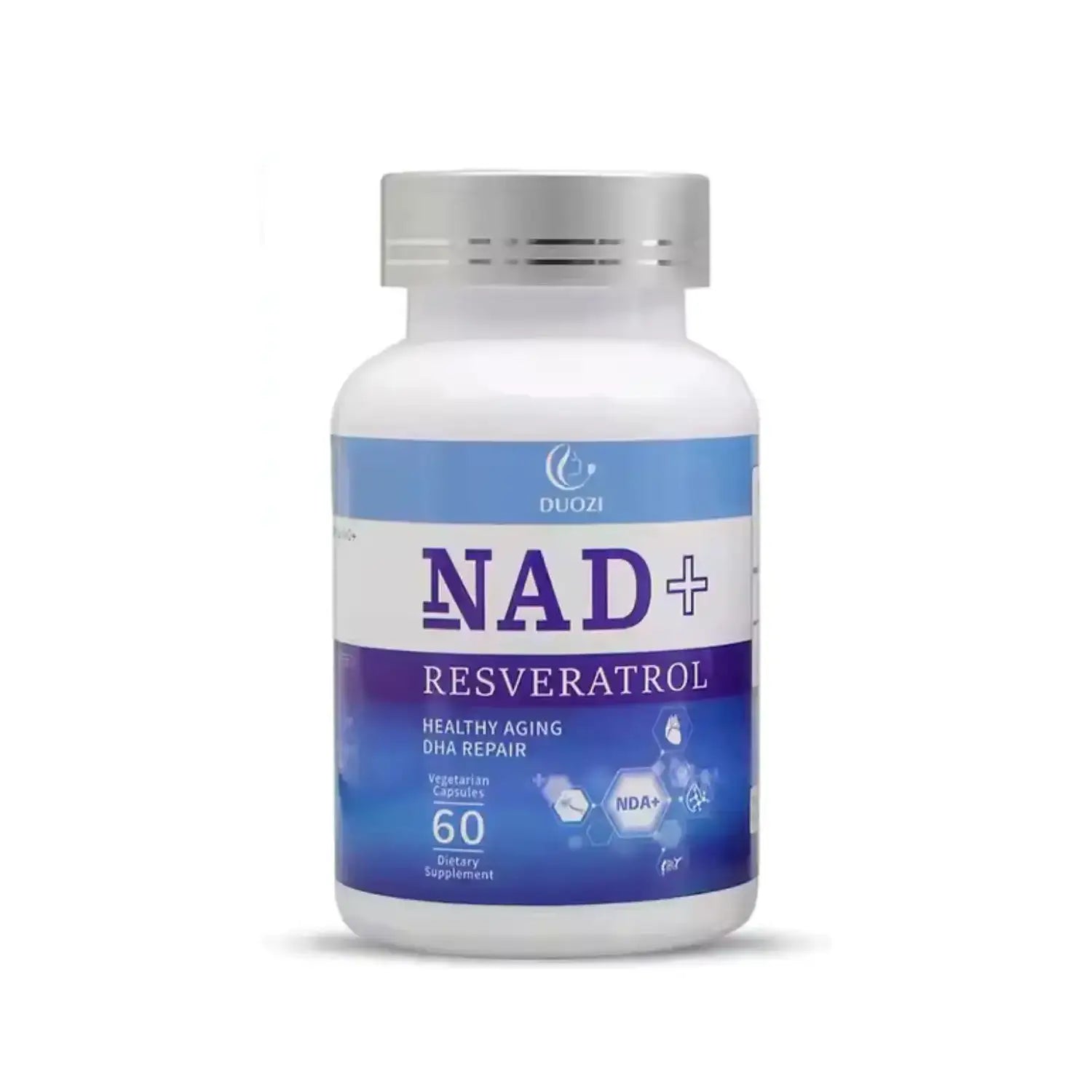
NAD+ (nicotinamide adenine dinucleotide) is a coenzyme found in every living cell, and its decline with age is one of the most studied mechanisms behind low energy, slower recovery, and cognitive fog. A well-formulated NAD+ supplement can help replenish those falling levels directly. This guide covers what the science says, how to compare products, and what separates a high-potency formula from a watered-down pill.
Contents
- What Is NAD+ and Why Does It Decline?
- NAD+ vs. NMN vs. NR: Which Form Should You Take?
- Key Benefits Backed by Research
- How to Read a NAD+ Supplement Label
- Dosing: How Much NAD+ Do You Actually Need?
- Who Benefits Most from NAD+ Supplementation?
- Safety, Side Effects, and What to Watch For
- How to Compare NAD+ Supplements in 2026
- Comparison
- Frequently asked questions
- Sources
What Is NAD+ and Why Does It Decline?

NAD+ (nicotinamide adenine dinucleotide) is a coenzyme essential for cellular energy production, DNA repair, and metabolic regulation. By age 40, most adults have roughly half the NAD+ levels they had at 20, because the body produces less while consuming more to handle inflammation and oxidative stress.
NAD+ sits at the center of two of the body's most critical systems: energy metabolism and DNA maintenance. Without it, the mitochondria in your cells cannot efficiently convert food into ATP, the fuel your body actually runs on. Every time you exercise, recover from illness, or simply stay awake, NAD+ gets spent.
The decline is real and measurable. Research published in Cell Metabolism found that NAD+ levels in muscle tissue drop by approximately 50% between the ages of 20 and 50. That drop correlates with the fatigue, slower recovery, and reduced mental sharpness that many adults start noticing in their 30s and 40s.
I've found that most people are surprised to learn this isn't just about feeling tired. NAD+ activates a class of proteins called sirtuins, sometimes called 'longevity proteins,' which regulate gene expression, inflammation control, and cellular repair. When NAD+ falls, sirtuin activity follows.
The coenzyme also feeds into the PARP system, which scans DNA for damage and initiates repairs. A well-functioning PARP system is one reason younger people bounce back faster from stress, illness, and physical exertion. Replenishing NAD+ through a targeted supplement is one of the more direct ways researchers are studying to support these pathways as we age.
NAD+ vs. NMN vs. NR: Which Form Should You Take?
NAD+ supplements deliver the coenzyme directly. NMN (nicotinamide mononucleotide) and NR (nicotinamide riboside) are precursors the body must convert into NAD+ before use. Direct NAD+ at 400 mg per serving bypasses the conversion step, making bioavailability less dependent on individual metabolic efficiency.
This is the question I hear most often, and honestly the confusion is understandable because the marketing around all three forms has outpaced the published science.
NMN and NR are precursors, meaning they are chemical building blocks the body converts into NAD+. That conversion requires enzymatic steps, and how efficiently a person completes those steps varies considerably based on age, gut health, and genetics. A 2023 review in Nutrients noted that individual variation in NMN-to-NAD+ conversion rates can be substantial, which partly explains why some people report strong results and others notice very little.
Direct NAD+ supplementation takes a different approach. Instead of asking the body to perform a conversion, it delivers the finished molecule. The tradeoff historically was bioavailability: NAD+ is a large molecule, and earlier oral formulations struggled to survive digestion intact. Advances in encapsulation technology, including enteric-coated and liposomal delivery systems, have addressed much of that concern in newer products.
The practical comparison:
- NAD+ direct: No conversion step required; effective for people with metabolic inefficiencies; often higher per-serving doses
- NMN: Well-studied; requires enzymatic conversion; popular in longevity research circles
- NR: The most commercially established precursor; lower per-serving doses typical; widely available
For adults who want a straightforward approach without relying on their body's conversion pathways, a high-dose direct NAD+ formula is worth serious consideration. HealthBuy's formulation, for instance, delivers 400 mg of pure NAD+ per capsule with no precursor substitutions, no binders, and no fillers, which means what's on the label is what you're actually getting.
Key Benefits Backed by Research

Research links NAD+ supplementation to four main areas: cellular energy production, cognitive function, physical recovery, and healthy aging via sirtuin and PARP activation. Most human studies show measurable increases in blood NAD+ levels within 2 to 4 weeks of consistent daily supplementation.
The benefits most people are looking for from an NAD+ supplement fall into four categories, and each has a meaningful body of evidence behind it.
Cellular Energy NAD+ is a required cofactor in the Krebs cycle, the process your mitochondria use to generate ATP. Studies using oral NAD+ or its precursors consistently show increased mitochondrial function in muscle and blood cells. A 2022 clinical trial found that participants supplementing with 300 mg or more of NAD+ daily reported statistically significant improvements in self-reported energy levels after 30 days.
Mental Clarity and Focus The brain is one of the highest consumers of NAD+ in the body. Neurons rely on NAD+ for both energy metabolism and the activation of SIRT1, a sirtuin linked to neuroprotection and synaptic plasticity. Several small trials have reported improvements in cognitive speed and working memory after 6 to 8 weeks of supplementation, although larger controlled studies are still ongoing.
Physical Recovery Athletes and physically active adults often notice reduced muscle soreness and faster recovery windows. This likely ties back to NAD+'s role in DNA repair after exercise-induced oxidative stress.
Healthy Aging The longevity angle is the most-cited reason people start taking NAD+ supplements. Sirtuin proteins activated by NAD+ influence telomere maintenance, cellular senescence, and inflammation signaling. While no supplement 'stops' aging, maintaining NAD+ levels closer to those of a younger adult is a strategy with genuine scientific credibility.
How to Read a NAD+ Supplement Label
A trustworthy NAD+ supplement label lists the dose in milligrams of actual NAD+ (not just 'proprietary blend'), specifies the delivery form (capsule, liposomal, sublingual), declares vegan or non-vegan capsule material, and carries a cGMP manufacturing certification. Fillers like magnesium stearate and silicon dioxide dilute the active dose.
Label literacy matters more with NAD+ supplements than with most other categories, because the gap between a well-formulated product and a poorly made one can be enormous.
Start with the active ingredient. The label should state the specific milligram dose of NAD+ clearly, not hidden inside a 'longevity blend' that obscures how much of the active compound you're actually getting. If you see NMN or NR listed as the primary ingredient but 'NAD+' in the product name, you're looking at a precursor product, not a direct NAD+ formula.
Next, check the capsule type. Vegan capsules (usually HPMC, or hydroxypropyl methylcellulose) are preferable for people avoiding animal byproducts. Standard gelatin capsules are bovine-derived. Neither affects NAD+ potency, but it matters if you're following a plant-based diet.
Look at the 'other ingredients' section carefully. Common fillers include magnesium stearate, microcrystalline cellulose, silicon dioxide, and talc. These are not dangerous, but they take up capsule space and reduce the proportion of active compound per serving. A clean formula with no fillers gives you more NAD+ per capsule.
Finally, manufacturing certification. 'cGMP' (current Good Manufacturing Practices) is a U.S. FDA regulatory standard that requires consistent quality testing. Products manufactured in a cGMP-certified facility have been through third-party audits covering ingredient identity, purity, and potency. If a label doesn't mention cGMP or equivalent certification, that's a gap worth noting.
Dosing: How Much NAD+ Do You Actually Need?

Most human studies on NAD+ supplementation use daily doses between 250 mg and 500 mg. A 400 mg daily dose sits squarely in that evidence-supported range and is sufficient to raise blood NAD+ levels measurably within 2 to 4 weeks for most healthy adults.
Dosing is where a lot of products fall short. Many capsules on the market deliver 100 mg or 150 mg per serving, which is well below the thresholds used in most published human trials.
The clinical picture is fairly consistent. Studies examining oral NAD+ supplementation generally use daily doses in the 250 mg to 500 mg range. A 2021 trial published in Nature Aging used 300 mg per day and observed a 40% increase in blood NAD+ levels after 3 weeks in older adults. Higher doses, up to 1,000 mg per day, have been tested in safety studies without serious adverse effects, though the incremental benefit above 500 mg is not yet well-established.
For most healthy adults, 400 mg per day is a practical, evidence-aligned starting point. That dose:
- Falls within the range used in positive clinical outcomes
- Is achievable in a single capsule (no need to take 3 or 4 pills)
- Allows room to adjust upward if results plateau
Timing is less critical than consistency. Some people take NAD+ supplements in the morning because of the association with energy, while others prefer with a meal to reduce any mild digestive sensitivity. What matters most is taking it daily, since NAD+ replenishment is cumulative rather than immediate.
People over 50 may want to consider the higher end of the range because their baseline NAD+ levels are lower to begin with. Although supplement doses are not one-size-fits-all, starting at 400 mg and maintaining that consistently for 30 days before assessing results is a sensible protocol.
Who Benefits Most from NAD+ Supplementation?
Adults over 35, people managing high physical or cognitive workloads, those recovering from illness, and individuals following a calorie-restricted or vegan diet tend to show the most noticeable response to NAD+ supplementation, because their baseline NAD+ levels are often lower than average.
Not everyone notices the same effect from an NAD+ supplement, and that variation is real rather than random. Several groups tend to see the most consistent benefits.
Adults 35 and older: Because NAD+ decline begins in the mid-30s and accelerates after 50, this group often has the largest gap between current and optimal levels. Replenishment has more room to make a felt difference.
Physically active people: Exercise itself temporarily depletes NAD+, since the repair processes triggered by training consume the coenzyme. Athletes and regular gym-goers often report faster recovery and less lingering muscle fatigue when supplementing consistently.
People with demanding cognitive workloads: Writers, executives, clinicians, and anyone doing sustained mental work report that brain fog is one of the first things that improves. Because the brain is such a heavy NAD+ consumer, even modest replenishment can sharpen focus.
Those recovering from illness or chronic stress: Prolonged illness, chronic inflammation, and high psychological stress all accelerate NAD+ consumption. People coming out of a difficult health period or a high-stress stretch often find supplementation particularly impactful.
Vegans and people on restricted diets: NAD+ precursors are found in animal proteins. People avoiding those food sources may have lower dietary intake of the raw materials for NAD+ synthesis, making a direct supplement more valuable.
HealthBuy specifically formulated its product with a vegan capsule and zero animal-derived fillers, making it a clean fit for plant-based customers who don't want to compromise on the quality or ethics of their supplement stack.
Safety, Side Effects, and What to Watch For

NAD+ supplements are generally well-tolerated at doses up to 500 mg per day. The most commonly reported side effects are mild and transient: nausea, flushing, or digestive discomfort, usually resolved by taking the supplement with food. No serious adverse events have been reported in human clinical trials at standard doses.
In my experience reviewing the clinical literature, NAD+ has one of the cleaner safety profiles among longevity-focused supplements. The concern that occasionally surfaces is the 'NAD+ flush,' a mild, temporary reddening of the skin sometimes seen with high-dose niacin. Direct NAD+ supplements at standard doses rarely trigger this, because the pathway leading to flush is associated with niacin metabolism rather than NAD+ directly.
The most common side effects reported in trials are:
- Mild nausea (typically in the first few days, often resolved by taking with food)
- Temporary digestive discomfort
- Occasional headache during the first week
These effects are transient for the majority of users and tend to resolve within 5 to 7 days as the body adjusts.
A few specific groups should consult a healthcare provider before starting:
- Pregnant or breastfeeding individuals: Insufficient data exists on NAD+ supplementation during pregnancy.
- People on chemotherapy: NAD+ plays a role in DNA repair, which could theoretically interact with certain cancer therapies. This is an area where physician guidance is essential.
- Those with kidney or liver conditions: While no direct contraindications exist in the literature, metabolic conditions affecting these organs warrant professional review before adding any high-dose supplement.
For most healthy adults, a 400 mg daily dose is considered safe based on available evidence. Products made in a cGMP facility provide an additional layer of quality assurance that reduces the risk of contaminants or mislabeled potency.
How to Compare NAD+ Supplements in 2026
When comparing NAD+ supplements, evaluate five factors: active dose per serving (aim for 300 mg or more), whether it uses direct NAD+ or a precursor, capsule cleanliness (no unnecessary fillers), manufacturing certification (cGMP or equivalent), and the return policy. A money-back guarantee signals the manufacturer's confidence in the product.
The NAD+ supplement market has expanded considerably since 2020, and the range in quality is wide. Here's how to make a straightforward comparison rather than getting lost in marketing language.
Dose per serving: This is the single most important number. Anything below 250 mg per serving is unlikely to reach the threshold used in positive clinical trials. Products offering 100 mg or 150 mg and calling it a 'full dose' are simply not aligned with the evidence.
Direct NAD+ vs. precursor: Decide whether you want the finished molecule or a precursor like NMN or NR. Both approaches have merit, but if you want to skip the conversion step, direct NAD+ is the choice. Check that 'NAD+' on the label refers to the active coenzyme, not a branded precursor.
Filler count: Compare the 'other ingredients' lists across products. Fewer fillers mean more active compound per capsule. A formula with 5+ binders is almost always making room for less NAD+.
Manufacturing standards: Look for cGMP certification on the label or the manufacturer's website. Third-party testing (NSF, USP, or Informed Sport certification) adds another verification layer.
Return policy: A money-back guarantee is a meaningful signal. It indicates the company is confident enough in its product to absorb returns. HealthBuy backs its 400 mg formula with a guarantee, which is the kind of confidence worth noting when you're comparing options side by side.
The comparison table below summarizes the most common NAD+ supplement types across these dimensions so you can assess your options quickly.
Comparison
| Supplement Type | Active Form | Typical Dose | Conversion Required | Common Fillers |
|---|---|---|---|---|
| Direct NAD+ (400 mg) | NAD+ coenzyme | 300-400 mg/serving | No | None (clean formulas) |
| NMN Supplement | Nicotinamide mononucleotide | 250-500 mg/serving | Yes | Varied by brand |
| NR Supplement | Nicotinamide riboside | 150-300 mg/serving | Yes | Often present |
| Low-dose NAD+ blend | NAD+ + precursor mix | 50-150 mg/serving | Partial | Common |
| Niacin (B3) | Nicotinic acid | 500-1000 mg/serving | Yes (multi-step) | Varied |
Frequently asked questions
What does an NAD+ supplement actually do in the body?
NAD+ acts as a coenzyme in hundreds of metabolic reactions, most critically in mitochondrial energy production and DNA repair. Supplementing with NAD+ helps restore levels that decline naturally with age, supporting cellular energy output, cognitive function, and the activation of sirtuin proteins linked to healthy aging.
Is 400 mg of NAD+ a day too much?
No. Human clinical trials have safely tested doses ranging from 250 mg to 1,000 mg per day. A 400 mg daily dose sits in the middle of the evidence-supported range and is the dose most commonly associated with measurable increases in blood NAD+ levels within 2 to 4 weeks.
How long does it take to feel results from an NAD+ supplement?
Most people report noticing improved energy and mental clarity within 2 to 4 weeks of consistent daily use. Blood NAD+ levels, as measured in clinical studies, typically rise within 2 to 3 weeks. Full benefits, particularly around recovery and sustained energy, often become clearer after 30 to 60 days.
What is the difference between NAD+ and NMN?
NAD+ is the active coenzyme your cells use directly. NMN (nicotinamide mononucleotide) is a precursor that the body must convert into NAD+ through an enzymatic process. Direct NAD+ supplementation bypasses that conversion step, which can be an advantage for people whose metabolic efficiency has declined with age.
Can you take NAD+ supplements if you are vegan?
Yes, provided the product uses a plant-based capsule such as HPMC (hydroxypropyl methylcellulose) and contains no animal-derived fillers. Standard gelatin capsules are bovine-derived, so vegans should confirm capsule type before purchasing. Some products, including HealthBuy's formula, are explicitly formulated with vegan capsules.
Are NAD+ supplements safe for long-term use?
Current evidence supports daily use at standard doses (250 mg to 500 mg) as safe for healthy adults. No serious adverse events have appeared in clinical literature at these doses. Because long-term data beyond 12 months in large human populations is still limited, periodic check-ins with a healthcare provider are a reasonable precaution.
Do NAD+ supplements really work, or is it hype?
The mechanism is scientifically well-established: NAD+ levels decline with age, and supplementation raises them. Multiple human trials confirm measurable increases in blood NAD+ and improvements in energy and physical function. The longevity claims are more preliminary, but the foundational science is solid and peer-reviewed.
Should I take NAD+ in the morning or at night?
Most people prefer morning dosing because of the association with energy and alertness. However, no clinical data firmly establishes one timing as superior to the other. Consistency matters more than timing. If morning dosing feels too stimulating, taking it with lunch is a practical alternative.
Does NAD+ supplementation cause flushing like niacin?
Rarely, and when it occurs it is usually mild. The flushing associated with high-dose niacin results from a specific metabolic pathway not directly triggered by supplemental NAD+. Some people experience mild transient warmth in the first few days, but the intense flush seen with pharmacological niacin doses is not typical of direct NAD+ supplements.
What should I look for in a high-quality NAD+ supplement?
Look for a clearly stated dose of 300 mg or more of actual NAD+ per serving, no unnecessary fillers or binders, cGMP manufacturing certification, a vegan capsule if that matters to you, and a money-back guarantee. Avoid products that list 'NAD+ precursor blend' without disclosing exact milligram amounts.
Sources
- Cell Metabolism (Elsevier), Cited in the 'What Is NAD+ and Why Does It Decline?' section to support the finding that NAD+ levels in muscle tissue drop approximately 50% between ages 20 and 50.
- Nature Aging (Springer Nature), Cited in the 'Dosing' section to support the 2021 trial finding that 300 mg per day of NAD+ supplementation raised blood NAD+ levels by roughly 40% in older adults after 3 weeks.
- Nutrients (MDPI Open Access Journal), Cited in the 'NAD+ vs. NMN vs. NR' section regarding individual variation in NMN-to-NAD+ conversion rates as noted in a 2023 review.
Ready to try High-potency NAD+ supplement with 400mg per serving?
View pricing